Conquest & Judges
Israel enters Canaan, and the Bronze Age collapses around them. The great empires fall, the Sea Peoples (including the Philistines) arrive, and iron begins to replace bronze. A dark age of tribal conflict, the era of the Judges.
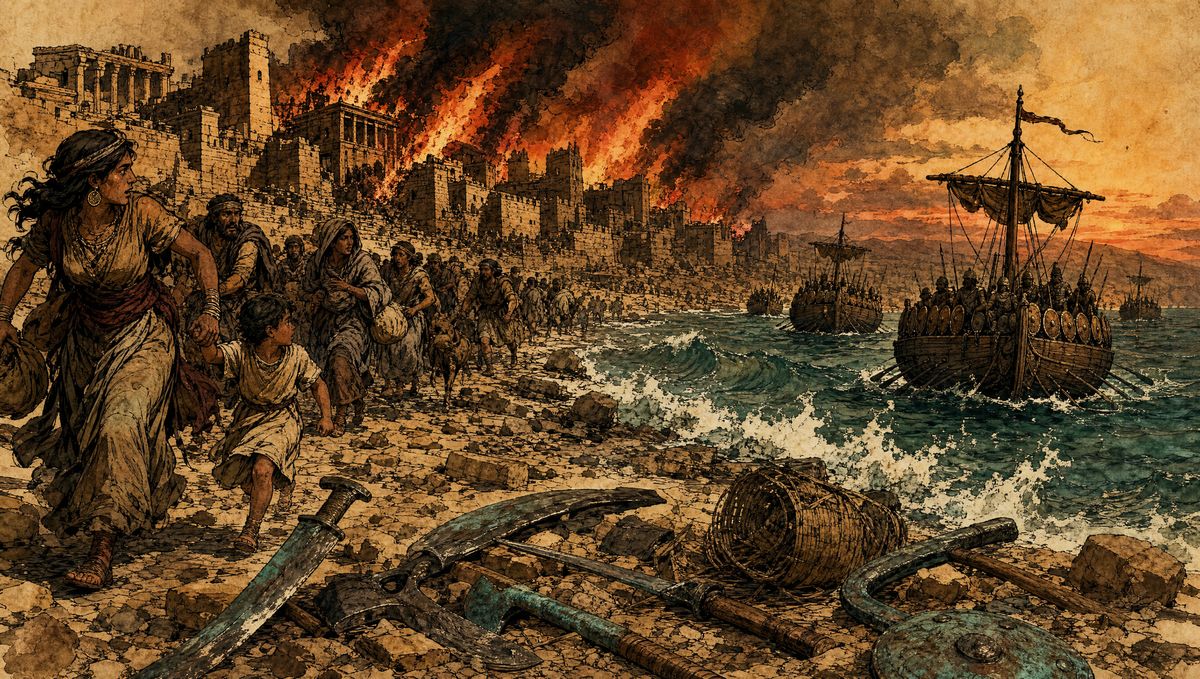
There was no king in Israel; 'everyone did what was right in his own eyes' (Judg 21:25). Leadership came from charismatic tribal chieftains, the Judges, raised up in crises. The Philistines were organized into five city-states (Gaza, Ashdod, Ashkelon, Gath, Ekron) under powerful 'lords' (seranim).
The collapse (c. 1200-1150 BCE) saw the fall of Mycenaean Greece, the Hittite empire, and many Canaanite cities go up in flames. Canaan's coastal cities were seized by the Philistines, who controlled the iron trade. Israel held the hill country, harder to reach, easier to defend.
Israel was a loose confederation of tribes bound by covenant and worship at the tabernacle. The Philistines brought a more urban, warlike, centralized society. Intermarriage, trade, and local Baal worship constantly pulled Israel's tribal identity toward Canaanite culture, the theme of the whole book of Judges.
Subsistence farming, wheat, barley, olives, grapes, figs, feeding each family and clan. The Philistines controlled the crucial iron-working technology, so Israel had to go to Philistine smiths even to sharpen farm tools (1 Sam 13). This monopoly was a lever of economic and military control.
Iron was the transformative metal. Iron tools and weapons were stronger and far more common than expensive bronze, but the Philistines guarded the technology. The Hebrew Bible's famous duel, David against Goliath, pits Israelite sling and speed against a Philistine giant in bronze armor (1 Sam 17).
- Joshua's conquest of Canaan and division of the land (Josh)
- The cycle of the Judges: Deborah, Gideon, Samson (Judg)
- Ruth and the family of Elimelech (Ruth)
- Samuel judges Israel; the Philistines capture the ark (1 Sam)
- Saul anointed the first king (1 Sam 8-10)
A reminder that when everyone does what is right in their own eyes, society fragments. The judges era warns about cycles of drifting away and needing rescue.