Egypt & the Exodus
Israel endures slavery in Egypt, then the Exodus and the giving of the Law at Sinai. Set in the Late Bronze Age, when Egypt was the superpower of the world and Canaan was its vassal province.
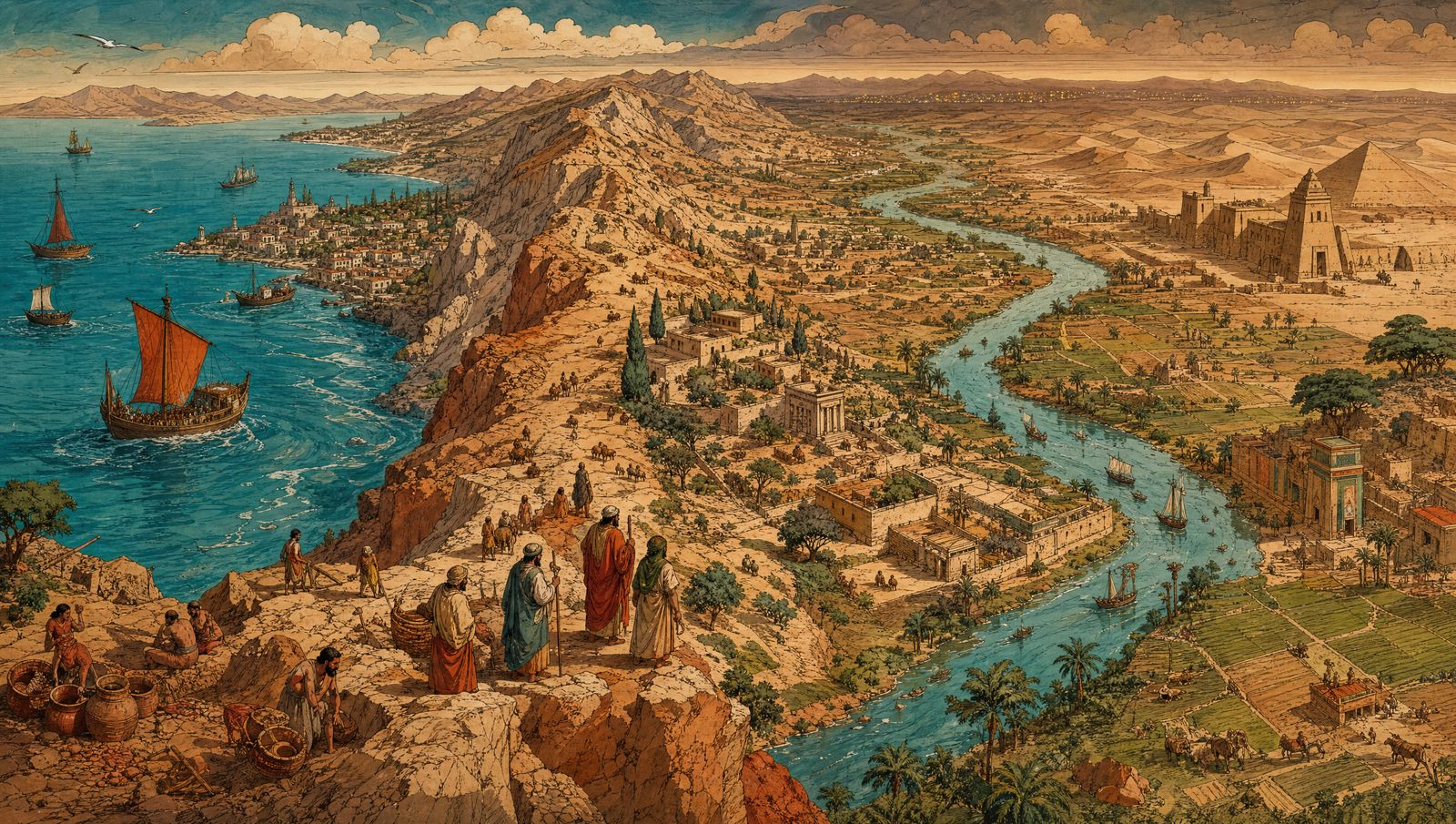
The New Kingdom pharaohs (18th-19th Dynasties) ruled an empire that stretched into Canaan and Syria. State-sponsored building projects needed huge labor forces, the context for the forced labor Israel endured. The Pharaoh was seen as a living god, absolute over land, king, and cult.
Egypt was the Nile corridor, a ribbon of irrigated farmland between desert. The Nile's annual flood made Egypt the richest, most stable food-basket in the ancient world. Canaan lay under Egyptian control, dotted with Egyptian garrison towns and tribute-paying city-states.
Egyptian society was rigidly stratified: the pharaoh, priests and nobles, scribes, craftsmen, farmers, and at the bottom, state laborers and slaves. Israel's 'mixed multitude' of brick-workers and field hands were the bottom rung, cheap labor for store-cities like Pithom and Rameses.
The state controlled grain, taxes, and labor, stored in massive granaries. Brick-making with straw (Exodus 5) was real state labor. Egyptian scribes kept everything on papyrus and record. Trade moved gold, copper, and luxury goods along the Nile and the eastern trade roads.
Egypt's army fielded massed archers, chariots (with spoked wheels and composite bows), and bronze khopesh swords. The famous Egyptian chariot corps chased Israel to the Red Sea, chariots were the shock weapon of the age, useless only in mud and swamp.
- Moses confronts Pharaoh; the ten plagues (Ex 7-12)
- The Exodus and crossing of the Red Sea (Ex 13-15)
- The Law at Mount Sinai (Ex 19-24)
- Forty years in the wilderness (Num)
The story of liberation from an oppressive system still speaks: God hears the cry of people under heavy labor and injustice, and freedom is a deliverance to be received and protected.