The Patriarchs
The world of Abraham: wandering pastoral nomads moving between city-states in the Middle Bronze Age, when Canaan was a patchwork of small walled towns and the great powers ruled from Egypt and Mesopotamia.
Egypt was under the Middle Kingdom, reaching its power south of the Delta. Mesopotamia was ruled by the great city-states of the Old Babylonian period (the era of Hammurabi). Canaan was a loosely governed buffer where no single power dominated, which is why a herding clan could wander in and out.
Canaan was not an empire but a corridor of small city-states, Jericho, Shechem, Bethel, Hebron, sitting on the land bridge between Egypt and Mesopotamia. Pastureland for grazing herds lay in the hill country, while the coastal plain and valleys carried the trade routes.
People lived as extended family clans (the 'house of the father'). Abraham's family were semi-nomadic herders who moved their flocks with the seasons, pledging loyalty to city rulers for grazing rights. Hospitality to strangers was a sacred duty, survival in the desert depended on it.
Wealth was measured in flocks, herds, silver, and servants. Trade moved along the Via Maris and King's Highway carrying copper, tin, timber, and textiles. Nomadic herders traded animals and wool to towns for grain and metal tools.
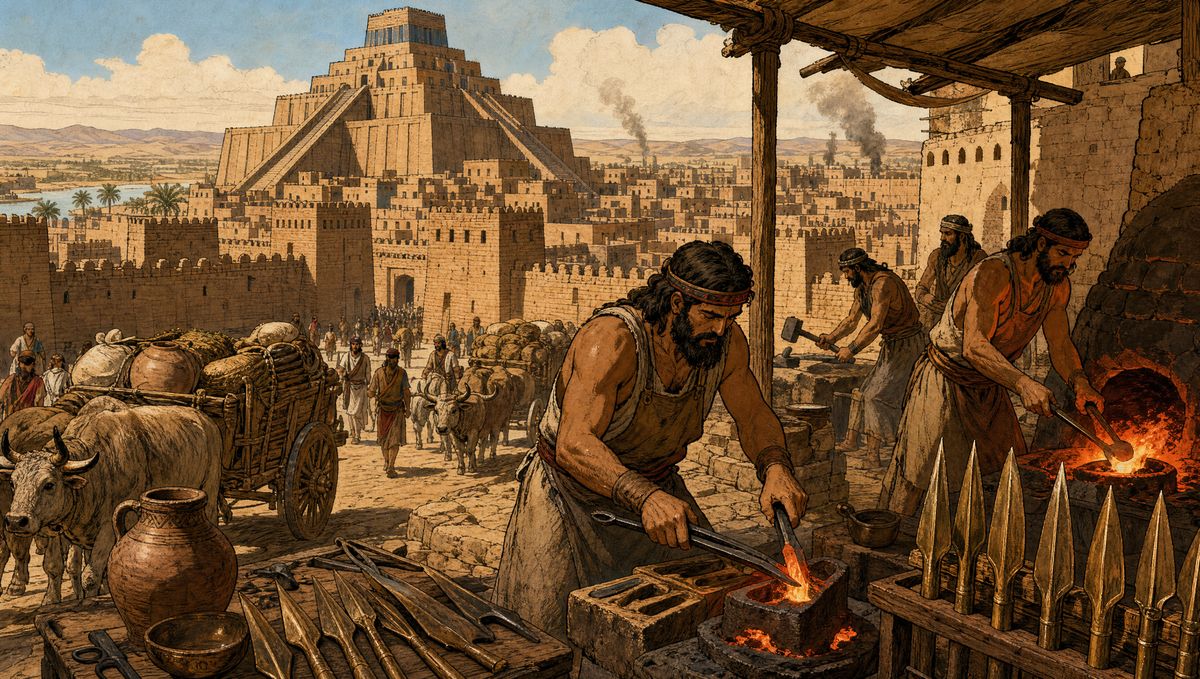
Bronze, an alloy of copper and tin, was the state-of-the-art material for swords, spears, and arrowheads. It was expensive and had to be imported, so only city rulers and their elite warriors could afford real bronze weapons. Most fighting was raiding between clans and towns.
- God calls Abram from Ur to Canaan (Gen 12)
- Abraham, Isaac, and Jacob live as herders in Canaan
- Jacob's sons sell Joseph into Egypt (Gen 37)
The trade-off between a settled, comfortable life and a life of faith and movement is as real now as when Abraham left Ur. Identity rooted in God rather than in place and security.