The Roman World
The world of Jesus and the apostles. Rome rules the Mediterranean with legions, roads, and taxes. Galilee is a busy, trade-linked region under a king called Herod; Jerusalem and its temple are under Roman control. The setting of the entire New Testament story.
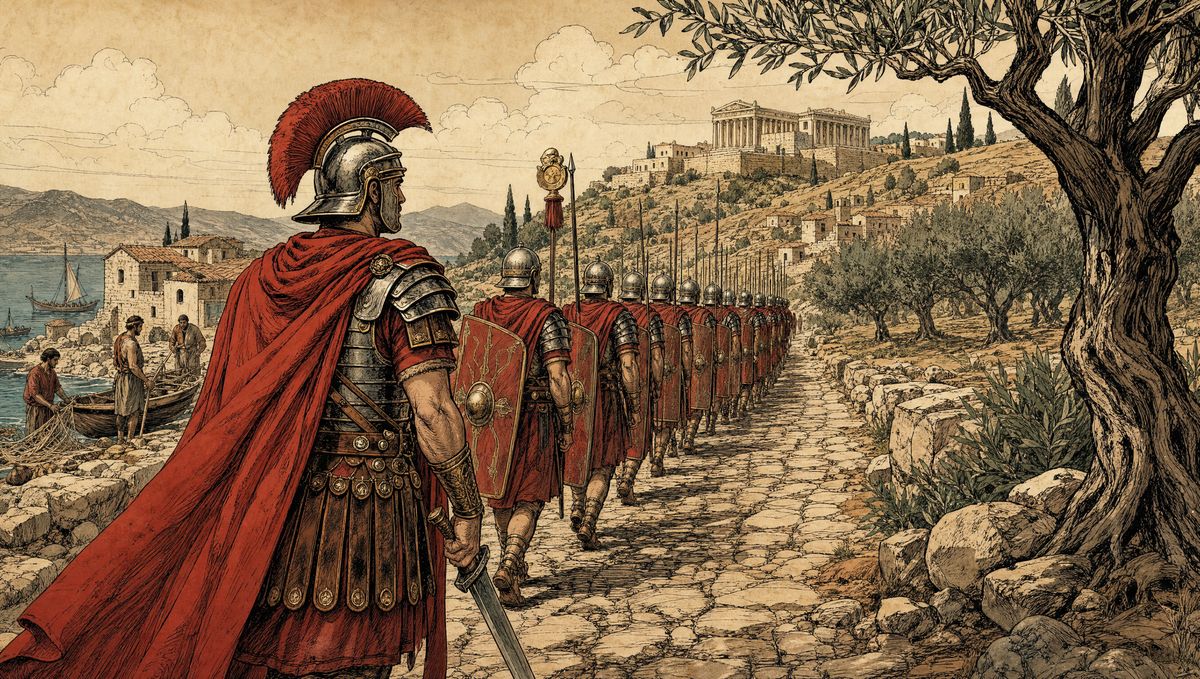
Rome ruled through the emperor (Augustus, Tiberius) and local client kings. Herod the Great rebuilt the temple and ruled as a Roman ally; after his death his sons and then Roman governors (like Pontius Pilate) took over. Roman soldiers, the 'legion', were the occupying power.
Rome united the whole Mediterranean into one empire, one law, one tax system, one road network, one language of trade (Greek) and of government (Latin). Palestine was a small, restless province. Galilee was green, fertile, and densely populated with villages around the Sea of Galilee; Jerusalem was the great pilgrimage city with its magnificent (Herod's) temple.
A deeply stratified world: the tiny Roman elite, provincial elites, and the mass of poor farmers, fishermen, day-laborers, and slaves. Galilee was a hotbed of working villagers who resented heavy Roman and Herodian taxes. Religious life centered on the temple, the synagogue, and the village Sabbath.
Money was everywhere, Roman denarii, tax collectors ('publicans'), tolls, and the temple economy of pilgrims, sacrifices, and money-changers. Heavy taxation squeezed the poor; the fishing trade of the Sea of Galilee was commercial and taxed. Jesus' parables are full of this world: debts, wages, denarii, vineyards, hired workers.
The Roman legion was the finest army of antiquity: disciplined, armored (iron helmets, mail, the gladius short sword, the scutum shield), and expert at siegecraft. Roman soldiers appear throughout the New Testament, the centurion at the cross, the guard at the tomb, the soldiers baptizing John. A soldier's 'peace' was kept by the sword.
- The birth and life of Jesus in Roman Judaea
- Jesus' crucifixion under the Roman governor Pontius Pilate
- The apostles spread the gospel across the Roman world (Acts)
- Paul's journeys on Roman roads to the great cities of the empire
Living as a faithful minority inside a powerful, pagan empire: the New Testament's question of loyalty to a different kingdom is still ours.